
Welcome!

The Digital Betsy-Tacy Project is a journey through Maud Hart Lovelace’s classic, much-loved series of children’s/young adult historical fiction, the Betsy-Tacy books. We gather and analyze key moments in the books as we explore the experience of revisiting literature and media from one’s youth. Come along for the ride!

Based at Rutgers University, the project provides an overview of some of the most important and revelatory vignettes in the Betsy-Tacy books and considers how they relate to and even help us understand life in a digital society. Click on the book titles in the navigation menu to view the posts associated with each book. New posts are added weekly on this site and in the LinkedIn group The Digital Betsy-Tacy Project (feel free to join!), following the project’s public launch at the Betsy-Tacy Convention in Mankato, MN in October 2025.

Subsequent phases of the project will explore in greater depth some of the themes that surface in this stage and may extend the study to other classic children’s books and media. All in all, it promises to be a fun-filled journey providing a fresh examination and reimagination of these classic works and how they may impact our own life stories and worlds.

We begin with the first book in the series, Betsy-Tacy, set in 1896-97 and published in 1940, and continue through to Betsy’s Wedding, set in 1917-19 and published in 1955. Throughout the ten volumes, the story becomes progressively more complex in style and substance as the characters age from childhood to early adulthood. An intimate look at early 20th century life that is drawn from Lovelace’s own personal experiences, the books are historically accurate yet completely timeless, and surprisingly relevant to the present day.

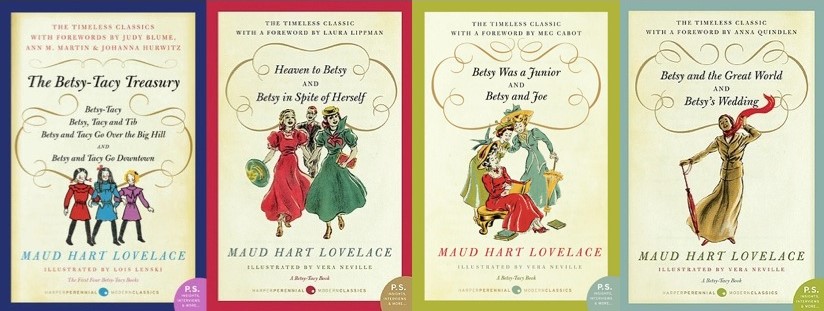
In the familiarity and warmth of the literature of the past can arise great wisdom, wit, insights, and lessons that are highly relevant to life today. The Digital Betsy-Tacy Project gathers and preserves them here, free of charge, for pleasure, practicality, and educational purposes. Browse, read, share, teach, enjoy! HarperCollins paperback versions of these books can be found at the links below:
Julia’s Voyage

Julia’s first year at the University is tumultuous. She enjoys her classes and is excited to hopefully pledge the Epsilon Iota sorority. As always, she attracts the attention of several devoted young men whose hearts she will surely break. But music is Julia’s first love, and alongside her family, her truest. She aspires to be an opera singer like her idol Geraldine Farrar, and knows that while she can pursue it after college, she really should be starting younger than that. And a university is no substitute for study abroad.

When Julia suffers the indignity of being blackballed by the sorority, Mr. and Mrs. Ray plot an alternate path for her musical exploration. They offer to send her abroad to London, Rome, Paris, and Berlin, a year of study with well-renowned singing, acting, and language teachers. She would have to forego a year at the University.

While the relative wealth of the Deep Valley families is not explicitly discussed in the Betsy-Tacy series, the Rays’ offer is a clear indication of a certain financial status. The Kellys would certainly not be able to send their children on such a trip; the Mullers would seem to have the means. But owning his own shoe store, Mr. Ray is able to provide such an arrangement for Julia (and presumably his other daughters as well; we will see Betsy go overseas later in the series). Then, as now, a trip of this magnitude would be a substantial investment. Anything transatlantic would have to be traveled by ocean liner.

For Julia, there is no question but that she will accept her family’s generous offer. Immediately, University life pales into significance. Julia no longer cares about sorority life, will not return to the U, and, in fact, will go on to sing professionally, an uncommon career path at the time, especially for a woman. She will take the family “with her” overseas via a steady stream of letters, gifts, and stories, and will inspire Betsy’s own international travel in Betsy and the Great World.

— For more on Geraldine Farrar, see: https://www.britannica.com/biography/Geraldine-Farrar

— For a brief look at travel throughout the ages, see: https://www.travelandleisure.com/what-travel-looked-like-decades-5439741

Betsy and Phil

Betsy’s new “Dramatic and Mysterious” identity, capped off by her re-branding as “Betsye,” captures the interest of Deep Valley High School heartthrob Phil Brandish. Phil is different from the boys in Betsy’s Crowd. He is new to town and a bit standoffish; he prefers to spend time with girls one on one than in groups. He even drives his own red auto! The girls in the Crowd peg him as a real catch.

Phil invites Betsy to the school dance and what Betsy later refers to as her first real love affair commences. Walking home from the dance, Phil tries to hold her hand. Betsy is unnerved; Julia had warned her that Phil might try to act “spoony.” Betsy puts a stop to Phil’s bold gesture, and Phil laughs, but kindly. The love affair is off to a solid, appropriate start.

Sexual attitudes have been among the biggest social changes in the last hundred or so years. In 1900, only about 6% percent of American women had engaged in premarital sex by the age of 19. That percentage is much higher today and has even been estimated to be over 70%, especially when a wide range of types of sexual behaviors are considered. Technological changes, such as contraception and increased access to information, are largely responsible for new sexual norms and attitudes. In Betsy’s day and environment, even kissing was reserved for the most serious of premarital relationships. And for the most part, only heterosexual relationships could be acknowledged publicly, due to the pathologizing and criminalization of homosexual activity of the time.

Betsy is careful to make sure that Phil never sees her silly, fun-loving side. She predicts, correctly, that he will neither understand nor appreciate it. After he observes her singing a raucous song parody that she invented about his red automobile, however, he becomes cold and distant, even though she tells him that she had devised the song long before they had become a couple. Betsy realizes that he really doesn’t know her, and also, that he doesn’t have much of a sense of humor.

Still, it hurts when they break it off, which unfortunately happens the night before the annual Essay Contest, in which Betsy is again facing Joe Willard. Betsy must compete after a sleepless, tear-filled night, and, once again, she loses to Joe. But she is heartened that she had done her best this time, as opposed to her lackluster freshman year effort, and that she had only lost the love of someone who did not know her. For he had only known “Betsye.”

On the history of premarital sex, see: https://cepr.org/voxeu/columns/shame-game-one-hundred-years-economic-model-rise-premarital-sex-and-its-de

On historical trends in homosexuality in Minnesota, see Paige Daniels’ Hamline University departmental honors project: https://digitalcommons.hamline.edu/cgi/viewcontent.cgi?article=1101&context=dhp

Betsy, Tony, and Joe – Freshman Year

Betsy experiences her first two big crushes in Heaven to Betsy. Both Tony and Joe will intrigue her and to some extent compete for her throughout the high school books. When Betsy meets Joe Willard at Butternut Center, she is immediately taken with his wit and good looks. But when Betsy first encounters Tony Markham at the Christian Endeavor social hour sponsored by the town’s Presbyterian church (presided over by Betsy’s new friend Bonnie Andrews), she is thunderstruck. He is charming, handsome, cool, slightly older, and new in town: the epitome of the “Tall, Dark Stranger” that she had dreamed of someday meeting.

When Tony visits the Ray house, he is warmly welcomed and feels instantly at home. Tony and Julia sing duets around the piano; with Herbert and Cab, he becomes a fixture in the kitchen, especially at Sunday Night Lunch; and perhaps most endearingly, Tony and Betsy’s younger sister Margaret become fast friends. Soon, Tony is all that Betsy can think about. But Tony only sees Betsy as a sister; his romantic feelings are for Bonnie. Betsy’s heart breaks time and again throughout the book as she tries and fails to get him to notice her as more than a friend.

Teenage romance was a prevalent theme in the young adult literature of the 1940s-1960s. Popular novelists of the era, including Rosamond duJardin, Betty Cavanna, Anne Emery, Beverly Clearly, and Janet Lambert created evocative, finely drawn worlds in which heroines experienced a (usually chaste) love for the very first time. Often in series format, these books offered their young readers a glimpse of a slightly more adult life toward which they might aspire. Maud Hart Lovelace’s realistic and heart-wrenching portrayals of teenage love, friendship, and growth place her among the most important of these wonderful authors.

Betsy, Tony, and Joe will cross paths often through the high school books. Betsy’s tempestuous crush on Tony is most prominent in this book, while her feelings for Joe develop more slowly and gradually throughout the remainder of the series. Betsy and Joe have more in common than Betsy and Tony, which turns out to matter! They share a love of writing and literature and ideas, and are selected as the freshman class representatives to compete in the important year-end Essay Contest.

Betsy spends more time at parties than she does at the library reading about the present and future value of the Phillipines, the topic on which she must become expert for the contest. When Joe offers to walk Betsy home after a study session in the library, and even suggests that he might share some of what he has learned about the Phillipines, he is rebuffed when Tony arrives to walk her home. This is not the first time that Joe and Betsy have crossed signals, and it won’t be the last.

To Betsy’s dismay, Tony’s intentions toward Betsy still aren’t romantic; Cab and Herbert join them for the goofy, rambunctious walk home. And soon Betsy will realize that her feelings for Tony are nothing more than friendship as well, and that she allowed her social life to thoroughly displace academics this year. Betsy loses handily to Joe in the Essay Contest, and with overwhelming regret, vows that she will prioritize her writing going forward….a critical step into a more fulfilling future.

For an overview of teen romance novelists of the era, see Carolyn Steele Agosta’s blog: https://www.carolynsteeleagosta.com/post/sweet-teen-romance-novels-1940s-1960s#:~:text=A%20few%20other%20popular%20authors,them%20humiliating%20and%20’mushy’.

Christmas Shopping

In Betsy and Tacy Go Downtown, we learn that for a few years now, Betsy, Tacy, and Tib have been going Christmas shopping together on the first day of Christmas vacation. Their shopping trips are loaded with traditions; chiefly, that while they visit many stores, they do not purchase anything until the very end. This year, they invite friend and occasional adversary Winona Root to join them, and they share and explain (and require compliance with) every tradition along the way. Winona is prominent in Downtown, inviting Betsy, Tacy, and Tib to the theater, joining them at a fancy party at Mrs. Poppy’s, and surreptitiously arranging to have one of Betsy’s poems published in her father’s newspaper.

The shopping expedition lays bare the girls’ vivid imaginations. They do not allow their meager funds (ten cents apiece) to constrain their fun, for until they arrive at the last store on their list, they do not shop to buy. They shop to shop! They approach this rather like “window shopping,” except that as they venture through Deep Valley’s bookstores, toy stores, and department stores, they examine and handle the merchandise that appeals to them. Tib even sits atop a seven-foot wooden horse. They then each select one item at each store– not to buy, but simply to select! Then they explain and defend their choice to the others, and have fun imagining its use.

With the advent of online shopping, or e-commerce, it is common and easy for an online shopper to click through many stores and items before choosing what will be purchased. The process can certainly take hours, as does the girls’ shopping trip. But generally, online shoppers shop to eventually BUY, and at a consistently increasing pace and volume. In 2025, online buyers spend an average of $5381 in the United States, while by 2026 that amount will likely rise to over $7000, and will surely continue to increase in the future. Even allowing for inflation (ten cents in 1907 would be worth about $3.42 in 2025), that’s a lot more spending than our four girls are prepared to do!

They do make a purchase at their final stop, though; a ten-cent Christmas ornament to adorn their respective trees, which will become a fine collection over the years as the tradition is faithfully repeated year to year. Nothing, Tacy explains, “is so much like Christmas as a Christmas-tree ornament,” while Tib adds, with her usual sensible perspective, “You get a lot for ten cents” (p. 126, Harper Trophy paperback edition, 1993). Given a multi-hour shopping trip, ice cream treats provided at the end of the day by their fathers, and the recommendations that some of the shop clerks will make to the girls’ parents when they embark on their Christmas shopping, that seems inarguable.

For some e-commerce shopping statistics, see: https://www.yaguara.co/online-shopping-statistics/

An inflation calculator: https://www.in2013dollars.com/


Crowning the Queen of Summer

Betsy, Tacy, Tib, Julia, and Katie decide to crown a Queen of the neighborhood to highlight the advent of summer. Tib and Julia are selected candidates for Queen, and they all spiritedly set out to acquire the votes of their neighbors. It turns out to be the biggest quarrel that the group of five would ever endure, for it turns out that Julia and Katie had solicited votes at the Ice Cream Social, which the younger girls did not attend, while Betsy, Tacy, and Tib had scoured Little Syria for votes, which the older girls are adament must be disallowed. These inequities give way to a full-blown battle, which gets tearful and personal, especially between Julia and Betsy.

Amidst the turmoil, the younger girls’ sojourns to Little Syria come to light. Their families had not known that they had made several trips there and had become so friendly with Naifi and her family and community. They are surprised and shocked that the girls had been so welcomed warmly and embraced by the Syrians; they had been rather apprehensive of their unfamiliar customs and ways. There is some discussion as to whether Arabic signatures on votes should be counted.

In the digital era, the internet and social media readily enable the spread of information about people who hail from different areas of the world, and their norms and culture. Still, there is no shortage of fear of those who are come from faraway places or are different in some way. Some of this is due to ethnocentrism: in general, people are most comfortable within the world which they have always inhabited. But to refuse to learn about and appreciate other cultures, to reject outright people and artifacts that seem different and strange, is a response as common today as it was then. It makes this story all the more remarkable.

Julia and Tib express no further appetite to be coronated given the distress that it is causing. Betsy and Julia make up, and the families decide that they want to learn more about the Syrian community in their midst and the little girl who, it turns out, would have been an actual princess (emeera) in Syria. Thrilled to learn this, the girls unanimously decide to crown Naifi Queen of Summer. Naifi’s family agrees that she can be so coronated, with the understanding that it be made clear to all attending that they are determined to become assimilated American citizens who are eager to learn and adopt American ways. Accordingly, the coronation features copious American flags, Katie’s recitation of the Gettysburg address, and Julia singing the Star Spangled Banner, while Naifi arrives resplendent in the chiffon, cashmere, and jewelry of her native country. A rousing time was had by all.

For more on the real-life Little Syria and its depiction in this book, see the sources cited in the prior post on this page, Befriending and Defending Naifi.


Befriending and Defending Naifi

Betsy, Tacy, and Tib discover a small immigrant community called Little Syria while exploring the Big Hill. One day, they meet and become friendly with a young girl from the community named Naifi.

Naifi does not speak English, and dresses and acts differently than the girls who live in Betsy’s neighborhood. She seems excitable, Betsy observes, and quite “darling” (p. 51, Harper Trophy paperback edition, 1993). They invite her to join their picnic, the girls begin to learn one a few words in one another’s languages, and they all just generally have a wonderful time. It is, they acknowledge, the oddest but most enjoyable picnic that they can remember.

It is difficult to know the precise number of immigrants, Syrian or otherwise, in the United States at any given point in time, but it is estimated that approximately 200,000 Syrians fleeing unrest had come to the United States by 1920, and that perhaps 100,000 have been in the U.S. in the 2020s. There was indeed a “Little Syria” of perhaps 2,000 immigrants near Mankato (Deep Valley) during the time period of the Betsy-Tacy series, many of whom were likely Lebanese. In Lovelace’s book Emily of Deep Valley, protagonist Emily Webster works for and with this immigrant community.

One day, Betsy, Tacy, and Tib happen upon a group of boys bullying Naifi — encircling her, calling her names, and pulling her hair. Tib, small but unafraid, steps in immediately to stand between Naifi and her biggest tormenter. Tacy follows bravely, and then Betsy. Order is eventually restored with the arrival of Betsy’s older sister Julia and Tacy’s older sister Katie (who intimidates everybody, apparently!), but not without some upsetting physical moments. Naifi flees, and the girls return home, shaken.

Julia tells Tib’s mother, Mrs. Muller, what happened, and why Tib’s clothes are torn and dirty. They are concerned about Mrs. Muller’s response. But Mrs. Muller, a daughter of immigrants herself, understands. She explains to the girls that the treatment Naifi endured is too often a part of the immigrant experience, and is glad that the girls are unharmed.

On the Lebanese and Syrians in Maud Hart Lovelace’s books, see Jia Tolentino’s “The Little Syria of Deep Valley” in The New Yorker: https://www.newyorker.com/books/second-read/the-little-syria-of-deep-valley

For some statistics and more recent stories of Syrian immigrants, see https://iir.gmu.edu/immigrant-stories-dc-baltimore/syria

Everything Pudding

Betsy, Tacy, and Tib have many adventures in the early Betsy-Tacy books. They love to climb the Big Hill, and sometimes they pretend to live there. In the first book, Betsy-Tacy, Betsy and Tacy bring their paper dolls “to life,” open a sand store, and turn an old piano box into a play house. In Betsy-Tacy and Tib, they expand industriously on this notion and build a small shelter out of wood in Tib’s basement. It is clear that the girls crave independence; to be as grown up as the actual grownups in their lives will allow.

In this vein, one of their most memorable escapades involves the invention, creation, and consumption of Everything Pudding — a mixture of literally every type of food that they can get their hands on in the kitchen one day. Flush with the excitement of being home alone for an afternoon and being allowed to use the stove and kitchen, the three girls decide that they want to create something extraordinary to eat. They want to make something that no one has ever thought to make before.

Betsy successfully argues (for Tacy and Tib nearly always defer to her stories and schemes) that the more foods that can be included in this dish, the better. So under Tib’s expert direction, they begin stirring together everything that they can find (bacon grease, sugar, milk, flour, raisins, coffee, tea, cornstrach, gelatine, soda, spices, an egg expertly broken by Tib) in a frying pan. Betsy dubs the concoction Everything Pudding, and they bravely serve it up and eat half a plate each. They toss the rest, and of course, feel quite ill later that night.

Cooking is a fun activity for children of any age! At the age of eight (the girls’ age in this book), children can begin following simple recipes, making salads, heating things up, and helping to plan the family meal. It’s a tactile, low-tech way to involve modern children in something fun, productive, and communal. It is also a great alternative to the increasingly common practice of children spending more and more time in front of a screen.

Betsy, Tacy, and Tib’s experiment would not have gone awry with proper supervision, of course, but they also would not have learned the lesson of Everything Pudding: that not all foods can be combined (Tib should have known this anyway!), that consulting recipes and directions makes sense, and that more of something is not always better. While most modern eight-year-olds are not given unsupervised access to a kitchen and permitted to cook in it, these lessons still hold. And they are most charmingly conveyed in this episode, which captures so much about the girls’ desires to be independent, original, and grown up.

For more on cooking with children, see: https://www.bbcgoodfood.com/howto/guide/guide-cookery-skills-age


Tacy’s Quarantine

When she is eight years old, Tacy contracts diptheria, a highly contagious bacterial infection that caused significant rates of mortality among children in the early 1900s. Tacy and her siblings are quarantined at home for an entire spring season. It lasts so long that Tacy grows taller (and prettier, Betsy notices!) during it. While a vaccine for diptheria had been in existence as of the 1890s, it was not widely available until 1920.

Betsy-Tacy and Tib chronicles this as a period of significant fear and worry for the Kelly family, the Rays, and the entire neighborhood. Deep Valley adults speak of Tacy’s illness in hushed tones. Betsy and Tib miss and speak of Tacy every day, but they continue with school, of course, still go out to play, and occasionally even forget to be sad. But then they quickly remember again. Betsy cleans out Tacy’s desk at the end of the school year, and it appears that Tacy’s quarantine will continue into the summer.

While diptheria is currently a controlled disease with relatively few reported cases, the world experienced a gigantic quarantine with the Covid-19 pandemic in 2020-2021. The scope of this quarantine brought social institutions and physical interactivity nearly to a halt for many months. The internet, social media, television, and radio were used to sustain everyday life and organizations to the extent possible. Society was instantly reshaped, stitched together by technologically enabled forms of communication and association. Going to school online became a reality for children across the globe. Hybrid forms of work and schooling emerged and expanded in the aftermath, many of which continue.

Tacy is unable to go to school or keep up with her friends (as a child in the digital age might do with the aid of technology), likely adding layers upon layers of loneliness atop her illness. Still, the children improvise, much as we must all improvise in the face of a sudden disruption in our lives. Tacy waves at Betsy and Tib from her window (today this might happen via video call), and gifts and notes are sent back and forth on a fishing pole (today, likely, they would be sent via texting, perhaps facilitated by a caregiver).

Eventually Tacy recovers, the house is fumigated, and the trio is happily reunited. But as her careful, measured account of this episode concludes, Lovelace takes care to note the toll that the illness had on Tacy’s mother. Mrs. Kelly holds back tears as she watches the girls resume their joyful romping and playing. Betsy, ever-observant, sees the barely hidden sadness in Mrs. Kelly’s trembling smile. It makes her “feel funny” (p. 83, Harper Trophy paperback edition, 1993), and prompts her to reflect further on life and death (see also the posts on The Birth of Margaret and Death of Baby Bee, on the Betsy-Tacy page on this site).

Sources: https://artsci.case.edu/dittrick/2014/04/29/deadly-diphtheria-the-childrens-plague/#:~:text=Diphtheria%20(Corynebacterium%20diphtheriae)%2C%20an,Before%20Dr.

The Birth of Margaret

Betsy and Julia head to their Uncle Edward’s farm that summer for a lengthy, fun visit. They learn a lot about farm life and have a good time. But eventually, Betsy is more than ready to return home.

She is shocked and upset to find her mother in bed, cuddling a brand new baby sister. Obviously, she had not been aware of the pregnancy. Betsy sees no need for a family expansion. She scorns Julia’s obvious delight in the newborn. She knows she is no longer the baby in the family. She feels strange and uncertain inside — a complex human emotion that Lovelace excels time and time again at depicting (see also, for example, the post on Tacy’s Quarantine in the Betsy, Tacy and Tib section of this site).

Betsy takes refuge in the barn and her tears start to flow. Tacy soon arrives, somehow knowing that Betsy would be there, and takes Betsy in her arms and comforts her. She explains that new babies are not necessarily unusual and unwelcome; her own large family welcomes them regularly, and so no one can count on being the baby forever. Betsy notices the role reversal in this conversation: Tacy is the one doing most of the talking and comforting Betsy, just as Betsy had comforted Tacy when Baby Bee passed away (and is ordinarily the talkier one!). The irony and the sweetness of this moment is not lost on Betsy. She starts to feel much better.

In the late 1800s and very early 1900s, home births were the norm, often attended by midwives. This began to change in the 1910 decade, when hospital deliveries facilitated by doctors, with the use of drugs and anesthesia, began to became more common. Today, more than 98% of all U.S. births take place in hospitals. There is now a thriving movement that encourages a return to home births (in situations where a pregnancy is without known complications), and even a return to midwifery and nurse-midwifery, which has been on the rise since the 1970s with the advent of feminism and women’s desire to regain control of the childbirth process.

Betsy and Julia are nominally permitted to name the baby, but are unable to agree on a name. Mr. Ray’s suggestion of Margaret is acceptable to all. The inclusion of Julia and Betsy (and even Tacy) in the naming process is a wonderful way to bring siblings who might otherwise feel as “strange” as Betsy does into the inner circle of the situation. The modern tech-assisted ability to detect (and then reveal) gender during pregnancy can provide another opportunity for sibling involvement, permitting an earlier and fuller imagination and visualization of the reality of the new baby. Involving Betsy and Julia in the naming is a wonderful illustration of the family dynamic of the Rays, and of the sensitivity that Bob and Jule Ray display time and again toward their children throughout the series.

On the history of home births, see: https://whyy.org/segments/how-did-birth-move-from-the-home-to-the-hospital-and-back-again/#:~:text=She%20says%20that%20around%201760,was%20not%20always%20safer%20childbirth.%E2%80%9D

On the history of midwifery, see: https://www.ohsu.edu/womens-health/brief-history-midwifery-america

The Death of Baby Bee

During Easter season, Tacy’s family, the Kellys, suffer the loss of baby Beatrice, whom they call Bee. Maud Hart Lovelace describes the impact of this death on Tacy, and by extension Betsy, with sensitivity and clarity, striking a tone that is neither alarming nor patronizing. It would have been easy to leave such an event out of a book for grade school children, but Lovelace obviously thought its inclusion important.

Tacy describes Bee’s funeral to Betsy in stark terms. Surrounded by flowers and candles, Bee looked “awful pretty,” Tacy relates, but her mother was “awful sad” (p. 60, Harper Trophy, 1993). In an effort to comfort Tacy, Betsy shares her view of heaven as a beautiful place where Bee will have fun, play music without having to be taught how, and know many things about the world — even more than Betsy and Tacy know, although she will forever be younger. Tacy points out that Bee is still very far away. Betsy develops her story to include a means by which messages can be delivered directly to heaven by birds, who travel to and fro, and Tacy suggests that they leave the birds a colored Easter egg to deliver to Bee. They do so. It is indeed comforting.

While Bee’s exact age and cause of death is not specified in this book, infant mortality was quite high in the early 1900s due to poor sanitation, limited access to doctors, and rudimentary medical knowledge. The infant mortality rate in the U.S. has dropped from 165 deaths per 1,000 births to just over 5 per 1,000 in 2025. These rates fluctuate greatly across the globe; medical and sanitation conditions are far from the same worldwide. But in most developed countries, diseases like diptheria and pertussis have been largely contained.

The death of Baby Bee illustrates the depth of the Betsy-Tacy friendship, and the depth that children’s friendships can have. Each knows just how to comfort the other. They look to one another in times of sorrow and joy, and take seriously the other’s fears, needs, and imaginings. Lovelace’s inclusion of the episode, so unusual in an children’s book (especially of the time), makes clear her regard for her young readers, and her commitment to portray the Betsy-Tacy universe honestly and respectfully.

Sources: https://www.pbs.org/fmc/timeline/dmortality.htm#:~:text=The%20infant%20mortality%20rate%20started,diphtheria%2C%20and%20pertussis%2C%20measles.